

1-30 June 2026
-
Spinal Health Month 2026
Healthy Spine – Healthy Mind. Get Back to Feeling Good this National Spinal Health Month (1-30 June 2026)
National Spinal Health Month (1 -30 June 2026) is the flagship initiative of the Australian Chiropractors Association (ACA). For 30 years, ACA’s annual community health initiative has shone a spotlight on spinal health issues that affect millions of Australians while encouraging individuals and communities across our nation to take proactive steps to improve spinal health.
With back pain recognised as one of the leading causes of disability worldwide, our 2026 campaign will spotlight the impact back pain has on limiting physical mobility, workplace productivity, sleep quality, and family and social participation. Importantly, we are encouraging Australians to take back control of their spinal health by adopting healthy lifestyle habits and consulting an ACA chiropractor to treat back pain and minimise long-term complications, including the effects of unresolved pain on mental health and quality of life.
A healthy spine supports a healthy mind, so this June, join the Spinal Health Month movement to learn and share practical strategies that can help prevent back pain and support spinal health, and reduce the economic and personal burden of MSDs.
-
About
An initiative of the Australian Chiropractors Association, National Spinal Health Month is Australia’s longest-running, award-winning awareness campaign dedicated to improving spinal health by preventing musculoskeletal disorders (MSDs).
Each year, musculoskeletal disorders (MSDs) cost the Australian economy more than $55 billion. With back pain remaining one of the leading causes of disability worldwide, Spinal Health Month 2026 aims to educate Australians about the impact of untreated and chronic back pain on everyday life, including its effects on mental health and overall wellbeing.
Past and present Spinal Health Week and Workspace Week participants
Annually, community leaders from governments (federal, state and local) not-for-profits, businesses, organisations and education facilities from across the nation join ACA’s movement to improve the spinal health of all Australians.
Government departments or agencies across Federal, State and Local Government
Department of Defence (Federal); Department of Planning, Lands and Heritage (WA); Department of Premier and Cabinet Tasmania; Legislative Council Tasmania, Parliament of Victoria, Parliament of Western Australia, Queensland Health, Queensland Parliament, SafeWork NSW; SafeWork SA; Tasmanian; Government, WorkSafe Tasmania and WorkSafe Victoria.
Associations and Not-For-Profits
Australian Chamber of Commerce and Industry, Australian Association of Psychologists Inc, Australian Council of State School Organisations, Australian Institute of Office Professionals (AIOP), Australian HR Institute, The Australian Industry Group, Australian Marketing Institute, Australian Psychological Society, Australian Society of Medical Imaging and Radiation Therapy, Chris O’Brien Lifehouse, Early Childhood Services and Training, Financial Counsellors’ Association of WA, Local Government association of Australia, Local Government Association of Tasmania, Massage and Myotherapy Association Australia, Master Builders Tasmania, Master Plumbers SA, National Disability Australia, Stats Australia, UNITED Spanish Latin American Welfare Association, Uniting Church (Queensland) and Work Healthy Australia.
Australian Federal and State Politicians (MPs, Senators, MLAs & MLCs) and Parties
Melissa Abbott MP (NSW), Jenny Aitchison MP (NSW), Rory Amon MP (NSW), Ros Bates MP (QLD), Vica Bayley MP (TAS), Kelly Brady MLC (WA), Geoff Brock MP (SA), Meg Brown MP (TAS), Liza Butler MP (NSW), Peter Cain MLA (ACT), Oly Carlson MP (NT), Sandra Carr MLC (WA), Leanne Castley MLA (ACT), Anthony Cianflone MP (VIC), Chris Crewther MP (VIC), Tanya Davies MP (NSW), Paul Fletcher MP (Federal), John Fulbrook MP (SA), Mike Gaffney MLC (TAS), Hon Colin de Grussa MLC (WA), Nathan Hagarty MP (NSW), David Harris MP (NSW), Michael Healy MP (QLD), Sonia Hornery MP (NSW), Catherine Hutchesson MP (SA), Tim James MP (NSW), Kristie Johnston MO (TAS), Charishma Kaliyanda MP (NSW), Nicole Lawder MLA (ACT), Caitlyn Long MP (NSW), Aileen MacDonald MLC (NSW), Hon Peter Malinausklas MP (SA), Jacqueline Marchant MP (NSW), Gary Maas MP (VIC), Hugh McDermott MP (NSW), Paul Mercurio MP (VIC), Louise Miller-Frost MP (Federal), Sophia Moermond MLC (WA), Hon Tung Ngo MLC (SA), Kim O’Keefe MP (VIC), Hon Madeleine Ogilvie MP (TAS), Shelly Payne MLC (WA), Hon Curtis Pitt MP (QLD), Penny Pratt MP (SA), John Quigley MLA (WA), Margaret Quirk MLA (WA), Dan Repacholi MP (Federal), Jordan Ryan MP (NSW), Tom Smith MP (QLD), Jimmy Sullivan MP (QLD), Angus Taylor MP (Federal), Olivia Savvas MP (SA), Liesl Tesch MP (NSW), Tanya Thompson MP (NSW), Kathy Tracey MP (NSW), Maria Vamvakinou MP (Federal), Gareth Ward MP (NSW), Kylie Wilkinson MO (NSW), Leslie Williams MP (NSW), Simon Wood MP (TAS), Dheran Young MLA (NT) and Mr Terry Young MP (Federal). ACT Greens and Tasmanian Liberal Government.
Local Government and Councils
Alice Springs Town Council (NT), Augusta Margaret River Shire (WA), Aurukun Shire Council (QLD), Ballina Shire Council (NSW), Baw Baw Shire Council (VIC), Bayside Council (NSW), Bogan Shire Council (NSW), Break O’Day Council (TAS), Brewarrina Shire Council (NSW), Bundaberg Regional Council (QLD), Burnie City Council (TAS), Cairns Regional Council (QLD), Circular Head Council (TAS), City of Albany (WA), Canterbury Bankstown City Council (NSW), Carpentaria Shire Council (QLD), Central Coast Council (NSW), Central Coast Council (TAS), City of Albany (WA), City of Ballarat (VIC), City of Kalamunda (WA), City of Melville (WA), City of Mitcham (SA), City of Parramatta (NSW), City of Perth (WA), City of Port Adelaide Enfield (SA), City of Rockingham (WA), City of Ryde (NSW), City of Salisbury (SA), City of Subiaco (WA), City of Sydney (NSW), City of Swan (WA), City of Wanneroo (WA), Coomalie Community Government Council (NT), Cootamundra-Gundagai Regional Council (NSW), Corangamite Shire Council (VIC), Cumberland Council (NSW), Devonport City Council (TAS), District Council of Lower Eyre Peninsula (SA), East Gippsland Shire Council (VIC), Forbes Shire Council (NSW), Frankston City Council (VIC), Glen Innes Severn Council (NSW), Glenorchy City Council (TAS), Greater Shepparton City Council (VIC), Griffith City Council (NSW), Gwydir Shire Council (NSW), Gympie Council (QLD), Hawkesbury City Council (NSW), Hornsby Shire Council (NSW), Hunter’s Hill Council (NSW), Huon Valley Council (TAS), Indigo Shire Council (VIC), Innerwest Council (NSW), Kangaroo Island Council (SA), Kempsey Shire Council (NSW), Kingston District Council (SA), Ku-ring-gai Council (NSW), Liverpool City Council (NSW), Livingstone Shire Council (QLD), Manningham City Council (VIC), Mareeba Shire Council (QLD), Merri-bek City Council (VIC), Midwestern Regional Council (NSW), Mildura Rural City Council (VIC), Mitchell Shire Council (VIC), Mornington Shire Council (QLD), Murrindindi Shire Council (VIC), Narrabri Shire Council (NSW), Narrandera Shire Council (NSW), Northern Beaches Council (NSW), Penrith City Council (NSW), Pormpuraaw Aboriginal Shire Council (QLD), Port Augusta City Council (SA), Port Pirie Regional Council (SA), Pyrenees Shire Council (VIC), Quilpie Shire Council (QLD), Randwick City Council (NSW), Renmark Paringa Council (SA), Scenic Rim Regional Council (QLD), Shire of Boyup Brook (WA), Shire of Capel (WA), Shire of Carnamah (WA), Shire of Chapman Valley (WA), Shire of Exmouth (WA), Shire of Harvey (WA), Shire of Kojonup (WA), Shire of Menzies (WA), Shire of Merredin (WA), Shire of Moora (WA), Shire of Narrogin (WA), Shire Of Tammin (WA), Shire of Victoria Plains (WA), Shire of West Arthur (WA), Shire of Wyalkatchem (WA), Snowy Monaro Regional Council (NSW), Snowy Valleys Council (NSW), South Burnett Regional Council (QLD), Southern Downs Regional Council (QLD), Southern Grampians Shire Council (VIC), Swan Hill Rural City Council (VIC), The Barossa Council (SA), The Hills Shire Council (NSW), Town of Mosman Park (WA), Town of Port Hedland (WA), Towong Shire Council (VIC), Wagga Wagga City Council (NSW), Waratah-Wynyard Council (TAS), Wattle Range Council (SA), Wentworth Shire Council (NSW), West Tamar Council (TAS), Whitehorse City Council (VIC), Willoughby City Council (NSW), Wollondilly Shire Council (NSW), Woollahra Council (NSW), Wyndham Council (VIC), Yarrabah Aboriginal Shire Council (QLD) and Yorke Peninsula Council (SA).
Universities
CQU – Central Queensland University, Griffith University, Murdoch University, Southern Cross University
-
Community Registrations
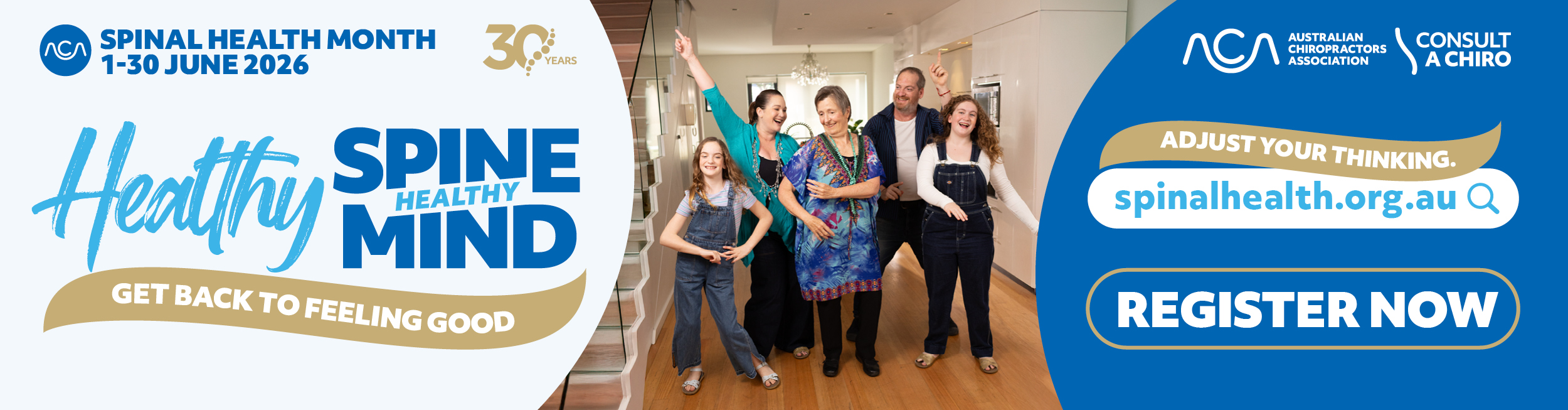
Register for National Spinal Health Month 2026
With over 6.1 million Australians living with MSDs including debilitating back pain, organisations including government agencies, corporations, businesses and education facilities nationally, are registering in the Spinal Health Month movement to help improve the spinal health of all Australians.
Why community support matters
By registering in national Spinal Health Month, you’ll be sharing a vital health message to help prevent back pain within your organisation and the wider community. We’re encouraging all Australians to adjust their thinking and take proactive steps towards better spinal health to get back to feeling good!
We invite you to:
- Share FREE downloadable resources with your networks
- Raise awareness across workplaces, schools, and communities
- Participate in the Align & Shine Awards, recognising outstanding community participation
Registered supporters receive access to our free digital toolkit, including:
- Back pain & mental health factsheets
- Ergonomic and postural checklists for workplaces and home
- Social media captions + images and graphics
- Printable posters and digital graphics
- Media release, promotional copy and newsletter templates
To register and access these FREE campaign resources, click here.
Annually, community leaders from governments (federal, state and local) not-for-profits, businesses, organisations and education facilities from across the nation join ACA’s movement to improve the spinal health of all Australians. A list of past and current community participants is available on our ‘About’ page.
Register Now -
Spinal Health Conditions
-
Back Pain
 If you’re among the 4 out of 5 Australians who experience back pain at some point in their lives, you’re not alone. Back pain is the single leading cause of disability globally and can often lead to poorer quality of life, psychological distress or bodily pain. If left untreated, back pain sufferers can sometimes develop a chronic back pain disorder that can lead to disability, isolation and increase mental health challenges.
In 2020-21, an estimated $3.4 billion was spent on the treatment and management of back problems in Australia. Long-term back problems are estimated to cost the Australian economy $638 billion in lost productivity over the next decade.
What are back problems?
Back problems are often a musculoskeletal issue, characterised by a variety of complications related to the bones, discs, joints, connective tissue, muscles and nerves of the back that can affect the neck (cervical spine), upper back (thoracic spine) and lower back (lumbar spine) as well as the sacrum and tailbone. Examples of back problems include back or spine pain (such as lower back pain, and sciatica), vertebrae and disc disorders (such as narrowing of the spinal canal, disc degeneration and bulge/herniation), and deforming disorders (such as scoliosis).
For about 8 in 10 Australians who suffer back pain, it’s not caused by any particular condition – this is called ‘chronic primary low back pain’ (also known as non-specific low back pain) which is most common in people aged 35 to 55 years, but it can affect people of all ages.
Back problems can cause lost social and physical activity, concentration and work capacity and are a significant cause of disability and lost productivity.
What causes back pain?
Back pain can stem from various factors, including muscle or ligament strain caused by heavy physical work; weakness in the back and abdominal muscles; frequent twisting, bending or lifting; poor posture or sitting for long periods (for example, sitting in an office environment); too little physical activity; being overweight and ageing.
Stress can also be a factor along with a range of medical conditions including disc problems, arthritis or osteoporosis.
Who is most at risk of back pain?
Working Australians who do a lot of physical work are among the highest percentage of Australians at risk of back pain because their work typically involves strenuous activities that strain the spine including lifting and repetitive actions such as bending, squatting or standing for extended periods – all can lead to musculoskeletal injuries causing back pain.
Older Australians, particularly those aged over 65 years, are more likely to develop chronic low back pain. Low back pain is the most common health problem among older Australians that can restrict activities and limit overall enjoyment of life.
Inactive Australians who don’t exercise and spend long hours sitting can develop poor posture, weight gain and musculoskeletal problems which, if left untreated, can lead to chronic back pain.
Why can back pain sometimes cause mental ill-health?
The link between MSDs, specifically back pain and depression is well documented in research studies that found people living with chronic back pain are at heightened risk of experiencing mental health problems. Some people with back pain may feel irritable or short-tempered. Others may worry about whether the pain will control their life, and some experience feelings of helplessness impacting their mental health. While chronic back pain can lead to developing psychological and social problems, depressive symptoms can worsen back pain and increase the disability associated with the condition. This in turn can exacerbate back pain’s negative impact on the mental health of sufferers. This vicious cycle, where back pain triggers a mental health problem that leads to the original back problem worsening can accelerate if left untreated to break the pain cycle.
-
Tech Neck
 What is tech neck?
Tech neck is the informal term used to describe Tension Neck Syndrome (TNS), a cervical spine-related musculoskeletal disorder (MSD) also referred to as ‘text neck’.
What causes tech neck?
Academic studies show incorrect and non-ergonomic posture habits while using mobile devices including smartphones and tablets; and poorly setup computers (including laptops) at home, school, university or in the workplace, can increase pressure on the cervical spine leading to tech neck.
Who are most at risk of tech neck?
Anyone who regularly uses a smartphone, tablet or computer in any setting including during leisure time, is at risk of developing tech neck. But it’s not the tech that’s the pain in the neck, it’s how we use it!
With over 34 million mobile phone connections and 95 percent of the Australian population accessing the internet via a smartphone, spending too much time with the head bent forward reading or scrolling smartphones or tablets has been proven to cause tech neck.
Computer use is also linked to tech neck. With computer usage an everyday activity for over 75% of Australians aged 16 to 64, the condition is common among those who frequently use computers particularly office workers and students.

How to prevent tech neck
Awareness of how to correctly use electronic devices and the importance of minimising the frequency and duration of use, plays a major role in preventing tech neck.
To help prevent tech neck, avoid incorrect, non-ergonomic posture habits when using smart devices and computers. Maintain good posture, take frequent breaks at regular intervals and do stretching exercises. Importantly, maintaining regular exercise not only helps to prevent tech neck but can improve spinal health and overall health and wellbeing.
ACA’s Top Ten Tips for Tech Neck Prevention
- SIT WITH COMFORTABLE UPRIGHT POSTURE with shoulders relaxed and feet flat on the floor.
- STOP BENDING THE NECK to look down at a phone or tablet. Hold the device at eye level.
- LIMIT THE TIME spent using a phone to 2 hours per day, especially during leisure time.
- USE BOTH HANDS or alternate between left and right when typing on a smartphone.
- DON’T WALK LOOKING DOWN at a phone. Hold your head up straight and engage with the world.
- TAKE REGULAR MOVEMENT BREAKS to look away from your device, move your neck from side to side and stretch every 10 minutes if using mobile devices and every 30 minutes if using computers.
- ENSURE COMPUTERS are ergonomically set up correctly so the monitor is at eye level.
- USE AN ADJUSTABLE ergonomic office chair so the knees are slightly lower than the hips.
- EXERCISE REGULARLY to maintain a healthy spine and overall health and wellbeing.
- CONSULT AN ACA CHIROPRACTOR to limit and treat spinal health problems including tech neck.
For parents, it’s also recommended that parents and carers limit screen time in accordance with the Australian Institute of Family Studies guidelines and keep children and young people active to maximise their physical and mental development, spinal health and overall health and wellbeing.
Get the Heads Up on Tech Neck!
To help minimise the occurrence of tech neck among Australians of all ages, ACA has developed a range of user-friendly resources including factsheets and checklists that are FREE to download and share.
These resources can be used at home, at school or displayed in the workplace to help minimise tech neck among students and colleagues including:
-
Headaches
 If you or someone you know are among the 7 million Australians who suffer from tension headaches or the 4.9 million who suffer from migraine causing lost social activity, concentration and work capacity; chiropractic healthcare can provide effective, drug-free pain relief to headache and migraine sufferers.
What are headaches?
The three main types of headaches are tension and cervicogenic (neck related) headaches and migraines.
Tension headaches are the most common form of headache causing mild to moderate pain. Described as a ‘hat band’ tightness around the forehead, temples and back of the head, tension headaches are often triggered by stress or fatigue. However, chronic tension headaches (those that persist for a long period of time or constantly recur), can be caused by ongoing stress and fatigue as well as physical and psychological or emotional health conditions. Chiropractic healthcare provides an effective, reliable, drug-free treatment for tension headaches and minimises recurrence.
Cervicogenic (neck related) headaches are due to a disorder of the top of the spine involving the bones, joints, muscles or ligaments in that area. Cervicogenic headache pain starts at the neck and can spread to the eyes, forehead, and temples. Pain is moderate to severe but not excruciating or throbbing. Cervicogenic headache is often associated with mild to moderate dizziness/light-headedness/unsteadiness. Studies confirm drug-free chiropractic healthcare is more effective in treating cervicogenic headaches than mobilisation or exercise alone.
Migraines are a chronic and disabling condition that often begins with a dull headache and develops into a constant, throbbing and pulsating pain at the temples and the front or back of the head. Sufferers can also experience nausea and vomiting and sensitivity to light and noise.
Migraines can be a complex and varied disorder with a range of severity, types and symptoms. 20% of migraines are ‘Classic’ migraines (with Aura) and 80% are ‘Common’ migraines (without Aura). An Aura is an important symptom that typically precedes the headache. Sufferers may also experience blurred vision, blind spots, and pins and needles in the face, hands, or arms.
Although migraines are often under-diagnosed and under-treated, chiropractors can help diagnose migraine and provide drug-free healthcare that’s been shown to decrease migraine duration and severity.
What causes headaches?
There are many causes of headaches but studies have shown some of the most common causes are stress and spinal health conditions. A wide range of activities that can cause spinal health conditions that lead to headaches include sports and exercise; poor posture (at work and home); physical activities (dancing, cycling, shopping, driving, gym, etc.); eye strain (including excessive screen time); dehydration; caffeine dependence and withdrawal; smoking and bright or noisy environments.
How can ACA chiropractors treat headaches and migraines?
ACA chiropractors are Australia’s leaders in chiropractic care – a proven, effective, drug-free, low-risk treatment for headaches, migraines and a range of spinal health conditions. Using specialised non-surgical techniques including specific spinal adjustments, various manual therapies and soft tissue techniques, ACA chiropractors treat the cause, not just the symptoms. They assess lifestyle factors and provide relaxation techniques to reduce reliance on medication that improves overall health and wellbeing. So, if you’re tired of headaches holding you back at work, home or school, consult an ACA chiropractor today for reliable drug-free pain relief from headaches and take back control of your health and wellbeing.
-
Back Pain
-
Factsheets & Resources
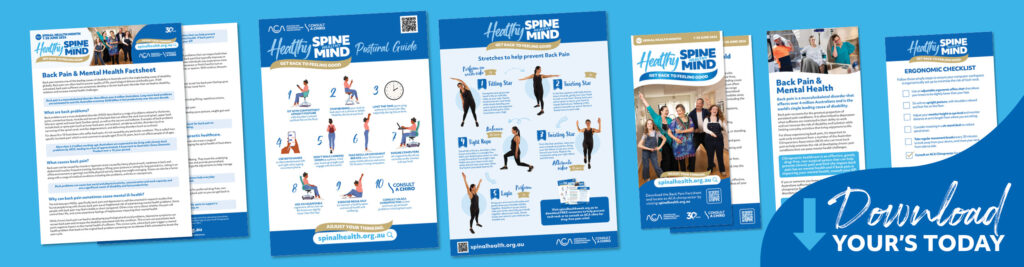
A Healthy Spine Supports a Healthy Mind!
To help minimise the occurrence of back pain among Australians of all ages, ACA has developed a range of user-friendly resources including factsheets that are FREE to download and share.
These resources can be used at home, at school or displayed in the workplace to help maximise spinal health and wellbeing and minimise the impact back pain can have on the mental health of sufferers. Download the factsheets now:
- Back Pain & Mental Health Factsheet
- Back Pain Factsheet
- Lifting & Bending Well Factsheet
- Standing Well Factsheet
- Sitting Well Factsheet
- Stress & MSDs Factsheet
Additional information to help prevent musculoskeletal disorders including back pain can be found in ACA’s range of unique flyers, checklists and posters, including the following:
- Back Pain & Mental Health DL Flyer
- Ergonomic Checklist
- Back Pain DL Checklist
- Healthy Spine Healthy Mind Postural Guide Poster
- Healthy Spine Healthy Mind Stretching Poster
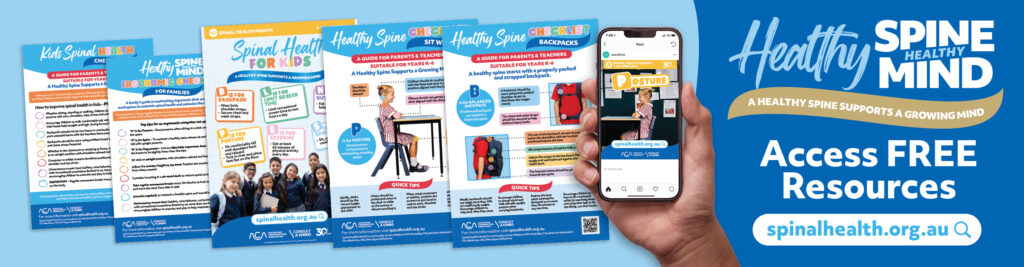
Schools Resources
During National Spinal Health Month, schools can help minimise the risk of students developing musculoskeletal conditions, including chronic back pain through participation in promoting the need to maintain positive spinal health habits among students.
These easy-to-use guides and checklists include tips on how children can maintain a healthy spine when sitting, standing, walking, using digital devices, ergonomics for computer use, and how to pack a backpack.
K-6 Primary
- K-6 Spinal Health For Kids Poster
- Kids Spinal Health Checklist
- Backpacks Healthy Spine Checklist
- Electronic Device Healthy Spine Checklist
- Ergonomics Healthy Spine Checklist
- Sit Well Healthy Spine Checklist
7-12 Secondary -
Consult a Chiro Podcast
 The Consult a Chiro Podcast is dedicated to providing valuable health and wellness information. Gain insights from experts, explore the latest research, and uncover practical tips for improving your health and wellbeing.
Learn about the benefits of chiropractic healthcare and how chiropractors can be a valuable part of your healthcare team.
Listen to the Consult a Chiro podcast today.


-
Consult a Chiro
 What are the health implications of unresolved back pain?
Unresolved and chronic back pain can limit physical mobility, impact workplace productivity and sleep quality, and affect family and social participation. If left untreated, back pain can also negatively impact mental health and overall wellbeing and quality of life.
How to minimise the impact of back pain and improve overall spinal health and wellbeing
For those suffering from back pain, studies show that it’s crucial to commence treatment promptly to prevent further functional decline. For effective treatment outcomes achieved through a combination of strengthening and stretching exercises, manual therapy and postural correction, consult an ACA chiro.
Every week over 400,000 chiropractic healthcare consultations help create well-adjusted Australians as ACA chiropractors play an important role in improving the spinal health of everyday Australians.
If you or someone you know are among the 4 million Australians who suffer from back pain, consult an ACA chiropractor. Chiropractic healthcare is an effective drug-free and low-risk treatment for musculoskeletal disorders and is one of the most preferred treatment options for back pain sufferers.
To back pain and improve your overall spinal health and wellbeing, find your local ACA chiropractor by visiting findachiro.org.au.
Find your local ACA chiropractor -
Competitions
-
SHM Online Competition
 Enter our SHM online competition by simply telling us in 50 words or less ‘how chiropractic care has helped relieve your back pain symptoms and improve your overall health and wellbeing’ for your chance to win an Apple Macbook Neo 13-inch laptop valued at $1,099! As a condition of entry participants must also be following our Consult a Chiro Facebook and Instagram pages.
*Competition commences 20 April 2026 and ends 1 July 2026.
Enter SHM Online Competition -
SHM Colouring Competition
 Calling all creative kids! We’re excited to invite your little ones to join our colouring competition for a chance to win fantastic prizes. Children aged 7-12 can compete for a selfie camera, while those 6 and under can win a Pour Palz large paint bear.
To enter, simply download and print the ‘Healthy Spine – Healthy Mind’ colouring sheet – then, let your child’s imagination run wild!
*Competition commences 20 April 2026 and ends 1 July 2026.
Entries can be sent via:
Post:
SHM Colouring Competition,
ACA, PO Box 255
Parramatta NSW 2125By email:
Download Colouring In Template
Email a scanned copy of the entry to [email protected]
-
SHM Online Competition
-
Align & Shine Awards

As part of Spinal Health Month (1-30 June 2026), the Australian Chiropractors Association (ACA) is excited to introduce the Align & Shine Awards – a new recognition program celebrating creativity, innovation and community spirit.
For 30 years ACA has led Australia’s premier musculoskeletal health awareness campaign. In 2026, the inaugural Align & Shine Awards will acknowledge outstanding contributions, and spotlight the collective impact of efforts to improve spinal health across the nation.
Participating in the Align & Shine Awards not only demonstrates your commitment to spinal health – it positions you as a leader in community health and engagement. Whether you’re hosting an event, getting engaging online content, or championing the messages within your local community, every contribution plays a role in helping Australians get back to feeling good.
Award Objectives
- Recognise and appreciate active community and member participation
- Encourage innovative and creative campaign engagement
- Foster a sense of community and shared purpose
Categories
All registered participants will receive a digital Certificate of Appreciation.
Following the campaign, participants will be invited to submit an online nomination for one or more of the following award categories:
- Outstanding Engagement Award
For consistent, active participation throughout Spinal Health Month. - Community Impact Award
Recognising individuals or organisations who made a meaningful difference in their local community. - Innovation Award
Celebrating inventive, fresh, unique and creative approaches to engaging with the public and promoting spinal health. - Social Media Champion Award
Presented to an ACA member who led the charge in online engagement and visibility.
Key Dates
- Spinal Health Month: 1-30 June 2026
- Awards Nominations open 2 July 2026
- Awards Nominations close 31 July 2026
- Awards Winners announced at the ACA 2026 Conference in August.
How to enter
- Step 1 Register: Take part in Spinal Health Month 2026 activities at spinalhealth.org.au
- Step 2 Nominate: Eligible participants will receive a link to submit their nomination via our online entry form.
- Step 3 Assessment: Nominations will be judged in August.
- Step 4 Announcement: Award winners will be announced in Late August at the 2026 ACA Conference and celebrated via ACA newsletters and social media.
It’s time to Align & Shine!
Get involved this Spinal Health Month and help Australians get back to feeling good. Together, we can create a healthier and happier Australia.
Align & Shine -
Media
22 June 2026
Seniors Carry Australia’s Heaviest Back Pain Burden: A Rising Mental Health Toll as Chronic Pain Takes Hold15 June 2026
1 in 2 Women with Back Pain Report Mental Health Impact as Cost of Living Prevents them Seeking Treatment8 June 2026
Australian Men’s Back Pain and the Workplace: A Silent Burden Driving a Growing Mental Health Crisis30 April 2026
Media Alert: Australia’s Silent Burden: Back Pain, Mental Health & Economic Cost of Inaction28 May 2025
Women Hit Hardest by Tech Neck Reveals New Data: Teens & Kids Also at Risk25 May 2025
New National Survey Reveals Tech Neck a Growing Public Health Concern30 April 2025
Media Alert: Tech Neck Time Bomb: Spinal Health Week Exposes Hidden Cost to Australians’ Health & ProductivityFor interviews with Australian Chiropractors Association representatives and case studies contact:
Media Contact:
Clare Collins | 0414 821 957 | [email protected]
Alice Collins | 0414 686 091 | [email protected]
- Previous Spinal Health Week Campaign Videos
Spinal Health Month 2026
Healthy Spine – Healthy Mind. Get Back to Feeling Good this National Spinal Health Month (1-30 June 2026)
National Spinal Health Month (1 -30 June 2026) is the flagship initiative of the Australian Chiropractors Association (ACA). For 30 years, ACA’s annual community health initiative has shone a spotlight on spinal health issues that affect millions of Australians while encouraging individuals and communities across our nation to take proactive steps to improve spinal health.
With back pain recognised as one of the leading causes of disability worldwide, our 2026 campaign will spotlight the impact back pain has on limiting physical mobility, workplace productivity, sleep quality, and family and social participation. Importantly, we are encouraging Australians to take back control of their spinal health by adopting healthy lifestyle habits and consulting an ACA chiropractor to treat back pain and minimise long-term complications, including the effects of unresolved pain on mental health and quality of life.
A healthy spine supports a healthy mind, so this June, join the Spinal Health Month movement to learn and share practical strategies that can help prevent back pain and support spinal health, and reduce the economic and personal burden of MSDs.
About
An initiative of the Australian Chiropractors Association, National Spinal Health Month is Australia’s longest-running, award-winning awareness campaign dedicated to improving spinal health by preventing musculoskeletal disorders (MSDs).
Each year, musculoskeletal disorders (MSDs) cost the Australian economy more than $55 billion. With back pain remaining one of the leading causes of disability worldwide, Spinal Health Month 2026 aims to educate Australians about the impact of untreated and chronic back pain on everyday life, including its effects on mental health and overall wellbeing.
Past and present Spinal Health Week and Workspace Week participants
Annually, community leaders from governments (federal, state and local) not-for-profits, businesses, organisations and education facilities from across the nation join ACA’s movement to improve the spinal health of all Australians.
Government departments or agencies across Federal, State and Local Government
Department of Defence (Federal); Department of Planning, Lands and Heritage (WA); Department of Premier and Cabinet Tasmania; Legislative Council Tasmania, Parliament of Victoria, Parliament of Western Australia, Queensland Health, Queensland Parliament, SafeWork NSW; SafeWork SA; Tasmanian; Government, WorkSafe Tasmania and WorkSafe Victoria.
Associations and Not-For-Profits
Australian Chamber of Commerce and Industry, Australian Association of Psychologists Inc, Australian Council of State School Organisations, Australian Institute of Office Professionals (AIOP), Australian HR Institute, The Australian Industry Group, Australian Marketing Institute, Australian Psychological Society, Australian Society of Medical Imaging and Radiation Therapy, Chris O’Brien Lifehouse, Early Childhood Services and Training, Financial Counsellors’ Association of WA, Local Government association of Australia, Local Government Association of Tasmania, Massage and Myotherapy Association Australia, Master Builders Tasmania, Master Plumbers SA, National Disability Australia, Stats Australia, UNITED Spanish Latin American Welfare Association, Uniting Church (Queensland) and Work Healthy Australia.
Australian Federal and State Politicians (MPs, Senators, MLAs & MLCs) and Parties
Melissa Abbott MP (NSW), Jenny Aitchison MP (NSW), Rory Amon MP (NSW), Ros Bates MP (QLD), Vica Bayley MP (TAS), Kelly Brady MLC (WA), Geoff Brock MP (SA), Meg Brown MP (TAS), Liza Butler MP (NSW), Peter Cain MLA (ACT), Oly Carlson MP (NT), Sandra Carr MLC (WA), Leanne Castley MLA (ACT), Anthony Cianflone MP (VIC), Chris Crewther MP (VIC), Tanya Davies MP (NSW), Paul Fletcher MP (Federal), John Fulbrook MP (SA), Mike Gaffney MLC (TAS), Hon Colin de Grussa MLC (WA), Nathan Hagarty MP (NSW), David Harris MP (NSW), Michael Healy MP (QLD), Sonia Hornery MP (NSW), Catherine Hutchesson MP (SA), Tim James MP (NSW), Kristie Johnston MO (TAS), Charishma Kaliyanda MP (NSW), Nicole Lawder MLA (ACT), Caitlyn Long MP (NSW), Aileen MacDonald MLC (NSW), Hon Peter Malinausklas MP (SA), Jacqueline Marchant MP (NSW), Gary Maas MP (VIC), Hugh McDermott MP (NSW), Paul Mercurio MP (VIC), Louise Miller-Frost MP (Federal), Sophia Moermond MLC (WA), Hon Tung Ngo MLC (SA), Kim O’Keefe MP (VIC), Hon Madeleine Ogilvie MP (TAS), Shelly Payne MLC (WA), Hon Curtis Pitt MP (QLD), Penny Pratt MP (SA), John Quigley MLA (WA), Margaret Quirk MLA (WA), Dan Repacholi MP (Federal), Jordan Ryan MP (NSW), Tom Smith MP (QLD), Jimmy Sullivan MP (QLD), Angus Taylor MP (Federal), Olivia Savvas MP (SA), Liesl Tesch MP (NSW), Tanya Thompson MP (NSW), Kathy Tracey MP (NSW), Maria Vamvakinou MP (Federal), Gareth Ward MP (NSW), Kylie Wilkinson MO (NSW), Leslie Williams MP (NSW), Simon Wood MP (TAS), Dheran Young MLA (NT) and Mr Terry Young MP (Federal). ACT Greens and Tasmanian Liberal Government.
Local Government and Councils
Alice Springs Town Council (NT), Augusta Margaret River Shire (WA), Aurukun Shire Council (QLD), Ballina Shire Council (NSW), Baw Baw Shire Council (VIC), Bayside Council (NSW), Bogan Shire Council (NSW), Break O’Day Council (TAS), Brewarrina Shire Council (NSW), Bundaberg Regional Council (QLD), Burnie City Council (TAS), Cairns Regional Council (QLD), Circular Head Council (TAS), City of Albany (WA), Canterbury Bankstown City Council (NSW), Carpentaria Shire Council (QLD), Central Coast Council (NSW), Central Coast Council (TAS), City of Albany (WA), City of Ballarat (VIC), City of Kalamunda (WA), City of Melville (WA), City of Mitcham (SA), City of Parramatta (NSW), City of Perth (WA), City of Port Adelaide Enfield (SA), City of Rockingham (WA), City of Ryde (NSW), City of Salisbury (SA), City of Subiaco (WA), City of Sydney (NSW), City of Swan (WA), City of Wanneroo (WA), Coomalie Community Government Council (NT), Cootamundra-Gundagai Regional Council (NSW), Corangamite Shire Council (VIC), Cumberland Council (NSW), Devonport City Council (TAS), District Council of Lower Eyre Peninsula (SA), East Gippsland Shire Council (VIC), Forbes Shire Council (NSW), Frankston City Council (VIC), Glen Innes Severn Council (NSW), Glenorchy City Council (TAS), Greater Shepparton City Council (VIC), Griffith City Council (NSW), Gwydir Shire Council (NSW), Gympie Council (QLD), Hawkesbury City Council (NSW), Hornsby Shire Council (NSW), Hunter’s Hill Council (NSW), Huon Valley Council (TAS), Indigo Shire Council (VIC), Innerwest Council (NSW), Kangaroo Island Council (SA), Kempsey Shire Council (NSW), Kingston District Council (SA), Ku-ring-gai Council (NSW), Liverpool City Council (NSW), Livingstone Shire Council (QLD), Manningham City Council (VIC), Mareeba Shire Council (QLD), Merri-bek City Council (VIC), Midwestern Regional Council (NSW), Mildura Rural City Council (VIC), Mitchell Shire Council (VIC), Mornington Shire Council (QLD), Murrindindi Shire Council (VIC), Narrabri Shire Council (NSW), Narrandera Shire Council (NSW), Northern Beaches Council (NSW), Penrith City Council (NSW), Pormpuraaw Aboriginal Shire Council (QLD), Port Augusta City Council (SA), Port Pirie Regional Council (SA), Pyrenees Shire Council (VIC), Quilpie Shire Council (QLD), Randwick City Council (NSW), Renmark Paringa Council (SA), Scenic Rim Regional Council (QLD), Shire of Boyup Brook (WA), Shire of Capel (WA), Shire of Carnamah (WA), Shire of Chapman Valley (WA), Shire of Exmouth (WA), Shire of Harvey (WA), Shire of Kojonup (WA), Shire of Menzies (WA), Shire of Merredin (WA), Shire of Moora (WA), Shire of Narrogin (WA), Shire Of Tammin (WA), Shire of Victoria Plains (WA), Shire of West Arthur (WA), Shire of Wyalkatchem (WA), Snowy Monaro Regional Council (NSW), Snowy Valleys Council (NSW), South Burnett Regional Council (QLD), Southern Downs Regional Council (QLD), Southern Grampians Shire Council (VIC), Swan Hill Rural City Council (VIC), The Barossa Council (SA), The Hills Shire Council (NSW), Town of Mosman Park (WA), Town of Port Hedland (WA), Towong Shire Council (VIC), Wagga Wagga City Council (NSW), Waratah-Wynyard Council (TAS), Wattle Range Council (SA), Wentworth Shire Council (NSW), West Tamar Council (TAS), Whitehorse City Council (VIC), Willoughby City Council (NSW), Wollondilly Shire Council (NSW), Woollahra Council (NSW), Wyndham Council (VIC), Yarrabah Aboriginal Shire Council (QLD) and Yorke Peninsula Council (SA).
Universities
CQU – Central Queensland University, Griffith University, Murdoch University, Southern Cross University
Community Registrations
Register for National Spinal Health Month 2026
With over 6.1 million Australians living with MSDs including debilitating back pain, organisations including government agencies, corporations, businesses and education facilities nationally, are registering in the Spinal Health Month movement to help improve the spinal health of all Australians.
Why community support matters
By registering in national Spinal Health Month, you’ll be sharing a vital health message to help prevent back pain within your organisation and the wider community. We’re encouraging all Australians to adjust their thinking and take proactive steps towards better spinal health to get back to feeling good!
We invite you to:
- Share FREE downloadable resources with your networks
- Raise awareness across workplaces, schools, and communities
- Participate in the Align & Shine Awards, recognising outstanding community participation
Registered supporters receive access to our free digital toolkit, including:
- Back pain & mental health factsheets
- Ergonomic and postural checklists for workplaces and home
- Social media captions + images and graphics
- Printable posters and digital graphics
- Media release, promotional copy and newsletter templates
To register and access these FREE campaign resources, click here.
Annually, community leaders from governments (federal, state and local) not-for-profits, businesses, organisations and education facilities from across the nation join ACA’s movement to improve the spinal health of all Australians. A list of past and current community participants is available on our ‘About’ page.
Register NowBack Pain
If you’re among the 4 out of 5 Australians who experience back pain at some point in their lives, you’re not alone. Back pain is the single leading cause of disability globally and can often lead to poorer quality of life, psychological distress or bodily pain. If left untreated, back pain sufferers can sometimes develop a chronic back pain disorder that can lead to disability, isolation and increase mental health challenges.
In 2020-21, an estimated $3.4 billion was spent on the treatment and management of back problems in Australia. Long-term back problems are estimated to cost the Australian economy $638 billion in lost productivity over the next decade.
What are back problems?
Back problems are often a musculoskeletal issue, characterised by a variety of complications related to the bones, discs, joints, connective tissue, muscles and nerves of the back that can affect the neck (cervical spine), upper back (thoracic spine) and lower back (lumbar spine) as well as the sacrum and tailbone. Examples of back problems include back or spine pain (such as lower back pain, and sciatica), vertebrae and disc disorders (such as narrowing of the spinal canal, disc degeneration and bulge/herniation), and deforming disorders (such as scoliosis).
For about 8 in 10 Australians who suffer back pain, it’s not caused by any particular condition – this is called ‘chronic primary low back pain’ (also known as non-specific low back pain) which is most common in people aged 35 to 55 years, but it can affect people of all ages.
Back problems can cause lost social and physical activity, concentration and work capacity and are a significant cause of disability and lost productivity.
What causes back pain?
Back pain can stem from various factors, including muscle or ligament strain caused by heavy physical work; weakness in the back and abdominal muscles; frequent twisting, bending or lifting; poor posture or sitting for long periods (for example, sitting in an office environment); too little physical activity; being overweight and ageing.
Stress can also be a factor along with a range of medical conditions including disc problems, arthritis or osteoporosis.
Who is most at risk of back pain?
Working Australians who do a lot of physical work are among the highest percentage of Australians at risk of back pain because their work typically involves strenuous activities that strain the spine including lifting and repetitive actions such as bending, squatting or standing for extended periods – all can lead to musculoskeletal injuries causing back pain.
Older Australians, particularly those aged over 65 years, are more likely to develop chronic low back pain. Low back pain is the most common health problem among older Australians that can restrict activities and limit overall enjoyment of life.
Inactive Australians who don’t exercise and spend long hours sitting can develop poor posture, weight gain and musculoskeletal problems which, if left untreated, can lead to chronic back pain.
Why can back pain sometimes cause mental ill-health?
The link between MSDs, specifically back pain and depression is well documented in research studies that found people living with chronic back pain are at heightened risk of experiencing mental health problems. Some people with back pain may feel irritable or short-tempered. Others may worry about whether the pain will control their life, and some experience feelings of helplessness impacting their mental health. While chronic back pain can lead to developing psychological and social problems, depressive symptoms can worsen back pain and increase the disability associated with the condition. This in turn can exacerbate back pain’s negative impact on the mental health of sufferers. This vicious cycle, where back pain triggers a mental health problem that leads to the original back problem worsening can accelerate if left untreated to break the pain cycle.
Tech Neck
What is tech neck?
Tech neck is the informal term used to describe Tension Neck Syndrome (TNS), a cervical spine-related musculoskeletal disorder (MSD) also referred to as ‘text neck’.
What causes tech neck?
Academic studies show incorrect and non-ergonomic posture habits while using mobile devices including smartphones and tablets; and poorly setup computers (including laptops) at home, school, university or in the workplace, can increase pressure on the cervical spine leading to tech neck.
Who are most at risk of tech neck?
Anyone who regularly uses a smartphone, tablet or computer in any setting including during leisure time, is at risk of developing tech neck. But it’s not the tech that’s the pain in the neck, it’s how we use it!
With over 34 million mobile phone connections and 95 percent of the Australian population accessing the internet via a smartphone, spending too much time with the head bent forward reading or scrolling smartphones or tablets has been proven to cause tech neck.
Computer use is also linked to tech neck. With computer usage an everyday activity for over 75% of Australians aged 16 to 64, the condition is common among those who frequently use computers particularly office workers and students.
How to prevent tech neck
Awareness of how to correctly use electronic devices and the importance of minimising the frequency and duration of use, plays a major role in preventing tech neck.
To help prevent tech neck, avoid incorrect, non-ergonomic posture habits when using smart devices and computers. Maintain good posture, take frequent breaks at regular intervals and do stretching exercises. Importantly, maintaining regular exercise not only helps to prevent tech neck but can improve spinal health and overall health and wellbeing.
ACA’s Top Ten Tips for Tech Neck Prevention
- SIT WITH COMFORTABLE UPRIGHT POSTURE with shoulders relaxed and feet flat on the floor.
- STOP BENDING THE NECK to look down at a phone or tablet. Hold the device at eye level.
- LIMIT THE TIME spent using a phone to 2 hours per day, especially during leisure time.
- USE BOTH HANDS or alternate between left and right when typing on a smartphone.
- DON’T WALK LOOKING DOWN at a phone. Hold your head up straight and engage with the world.
- TAKE REGULAR MOVEMENT BREAKS to look away from your device, move your neck from side to side and stretch every 10 minutes if using mobile devices and every 30 minutes if using computers.
- ENSURE COMPUTERS are ergonomically set up correctly so the monitor is at eye level.
- USE AN ADJUSTABLE ergonomic office chair so the knees are slightly lower than the hips.
- EXERCISE REGULARLY to maintain a healthy spine and overall health and wellbeing.
- CONSULT AN ACA CHIROPRACTOR to limit and treat spinal health problems including tech neck.
For parents, it’s also recommended that parents and carers limit screen time in accordance with the Australian Institute of Family Studies guidelines and keep children and young people active to maximise their physical and mental development, spinal health and overall health and wellbeing.
Get the Heads Up on Tech Neck!
To help minimise the occurrence of tech neck among Australians of all ages, ACA has developed a range of user-friendly resources including factsheets and checklists that are FREE to download and share.
These resources can be used at home, at school or displayed in the workplace to help minimise tech neck among students and colleagues including:
Headaches
If you or someone you know are among the 7 million Australians who suffer from tension headaches or the 4.9 million who suffer from migraine causing lost social activity, concentration and work capacity; chiropractic healthcare can provide effective, drug-free pain relief to headache and migraine sufferers.
What are headaches?
The three main types of headaches are tension and cervicogenic (neck related) headaches and migraines.
Tension headaches are the most common form of headache causing mild to moderate pain. Described as a ‘hat band’ tightness around the forehead, temples and back of the head, tension headaches are often triggered by stress or fatigue. However, chronic tension headaches (those that persist for a long period of time or constantly recur), can be caused by ongoing stress and fatigue as well as physical and psychological or emotional health conditions. Chiropractic healthcare provides an effective, reliable, drug-free treatment for tension headaches and minimises recurrence.
Cervicogenic (neck related) headaches are due to a disorder of the top of the spine involving the bones, joints, muscles or ligaments in that area. Cervicogenic headache pain starts at the neck and can spread to the eyes, forehead, and temples. Pain is moderate to severe but not excruciating or throbbing. Cervicogenic headache is often associated with mild to moderate dizziness/light-headedness/unsteadiness. Studies confirm drug-free chiropractic healthcare is more effective in treating cervicogenic headaches than mobilisation or exercise alone.
Migraines are a chronic and disabling condition that often begins with a dull headache and develops into a constant, throbbing and pulsating pain at the temples and the front or back of the head. Sufferers can also experience nausea and vomiting and sensitivity to light and noise.
Migraines can be a complex and varied disorder with a range of severity, types and symptoms. 20% of migraines are ‘Classic’ migraines (with Aura) and 80% are ‘Common’ migraines (without Aura). An Aura is an important symptom that typically precedes the headache. Sufferers may also experience blurred vision, blind spots, and pins and needles in the face, hands, or arms.
Although migraines are often under-diagnosed and under-treated, chiropractors can help diagnose migraine and provide drug-free healthcare that’s been shown to decrease migraine duration and severity.
What causes headaches?
There are many causes of headaches but studies have shown some of the most common causes are stress and spinal health conditions. A wide range of activities that can cause spinal health conditions that lead to headaches include sports and exercise; poor posture (at work and home); physical activities (dancing, cycling, shopping, driving, gym, etc.); eye strain (including excessive screen time); dehydration; caffeine dependence and withdrawal; smoking and bright or noisy environments.
How can ACA chiropractors treat headaches and migraines?
ACA chiropractors are Australia’s leaders in chiropractic care – a proven, effective, drug-free, low-risk treatment for headaches, migraines and a range of spinal health conditions. Using specialised non-surgical techniques including specific spinal adjustments, various manual therapies and soft tissue techniques, ACA chiropractors treat the cause, not just the symptoms. They assess lifestyle factors and provide relaxation techniques to reduce reliance on medication that improves overall health and wellbeing. So, if you’re tired of headaches holding you back at work, home or school, consult an ACA chiropractor today for reliable drug-free pain relief from headaches and take back control of your health and wellbeing.
Factsheets & Resources
A Healthy Spine Supports a Healthy Mind!
To help minimise the occurrence of back pain among Australians of all ages, ACA has developed a range of user-friendly resources including factsheets that are FREE to download and share.
These resources can be used at home, at school or displayed in the workplace to help maximise spinal health and wellbeing and minimise the impact back pain can have on the mental health of sufferers. Download the factsheets now:
- Back Pain & Mental Health Factsheet
- Back Pain Factsheet
- Lifting & Bending Well Factsheet
- Standing Well Factsheet
- Sitting Well Factsheet
- Stress & MSDs Factsheet
Additional information to help prevent musculoskeletal disorders including back pain can be found in ACA’s range of unique flyers, checklists and posters, including the following:
- Back Pain & Mental Health DL Flyer
- Ergonomic Checklist
- Back Pain DL Checklist
- Healthy Spine Healthy Mind Postural Guide Poster
- Healthy Spine Healthy Mind Stretching Poster
Schools Resources
During National Spinal Health Month, schools can help minimise the risk of students developing musculoskeletal conditions, including chronic back pain through participation in promoting the need to maintain positive spinal health habits among students.
These easy-to-use guides and checklists include tips on how children can maintain a healthy spine when sitting, standing, walking, using digital devices, ergonomics for computer use, and how to pack a backpack.
K-6 Primary
- K-6 Spinal Health For Kids Poster
- Kids Spinal Health Checklist
- Backpacks Healthy Spine Checklist
- Electronic Device Healthy Spine Checklist
- Ergonomics Healthy Spine Checklist
- Sit Well Healthy Spine Checklist
Consult a Chiro Podcast
The Consult a Chiro Podcast is dedicated to providing valuable health and wellness information. Gain insights from experts, explore the latest research, and uncover practical tips for improving your health and wellbeing.
Learn about the benefits of chiropractic healthcare and how chiropractors can be a valuable part of your healthcare team.
Listen to the Consult a Chiro podcast today.
Consult a Chiro
What are the health implications of unresolved back pain?
Unresolved and chronic back pain can limit physical mobility, impact workplace productivity and sleep quality, and affect family and social participation. If left untreated, back pain can also negatively impact mental health and overall wellbeing and quality of life.
How to minimise the impact of back pain and improve overall spinal health and wellbeing
For those suffering from back pain, studies show that it’s crucial to commence treatment promptly to prevent further functional decline. For effective treatment outcomes achieved through a combination of strengthening and stretching exercises, manual therapy and postural correction, consult an ACA chiro.
Every week over 400,000 chiropractic healthcare consultations help create well-adjusted Australians as ACA chiropractors play an important role in improving the spinal health of everyday Australians.
If you or someone you know are among the 4 million Australians who suffer from back pain, consult an ACA chiropractor. Chiropractic healthcare is an effective drug-free and low-risk treatment for musculoskeletal disorders and is one of the most preferred treatment options for back pain sufferers.
To back pain and improve your overall spinal health and wellbeing, find your local ACA chiropractor by visiting findachiro.org.au.
Find your local ACA chiropractorSHM Online Competition
Enter our SHM online competition by simply telling us in 50 words or less ‘how chiropractic care has helped relieve your back pain symptoms and improve your overall health and wellbeing’ for your chance to win an Apple Macbook Neo 13-inch laptop valued at $1,099! As a condition of entry participants must also be following our Consult a Chiro Facebook and Instagram pages.
*Competition commences 20 April 2026 and ends 1 July 2026.
Enter SHM Online CompetitionSHM Colouring Competition
Calling all creative kids! We’re excited to invite your little ones to join our colouring competition for a chance to win fantastic prizes. Children aged 7-12 can compete for a selfie camera, while those 6 and under can win a Pour Palz large paint bear.
To enter, simply download and print the ‘Healthy Spine – Healthy Mind’ colouring sheet – then, let your child’s imagination run wild!
*Competition commences 20 April 2026 and ends 1 July 2026.
Entries can be sent via:
Post:
SHM Colouring Competition,
ACA, PO Box 255
Parramatta NSW 2125
By email:
Email a scanned copy of the entry to [email protected]
Align & Shine Awards
As part of Spinal Health Month (1-30 June 2026), the Australian Chiropractors Association (ACA) is excited to introduce the Align & Shine Awards – a new recognition program celebrating creativity, innovation and community spirit.
For 30 years ACA has led Australia’s premier musculoskeletal health awareness campaign. In 2026, the inaugural Align & Shine Awards will acknowledge outstanding contributions, and spotlight the collective impact of efforts to improve spinal health across the nation.
Participating in the Align & Shine Awards not only demonstrates your commitment to spinal health – it positions you as a leader in community health and engagement. Whether you’re hosting an event, getting engaging online content, or championing the messages within your local community, every contribution plays a role in helping Australians get back to feeling good.
Award Objectives
- Recognise and appreciate active community and member participation
- Encourage innovative and creative campaign engagement
- Foster a sense of community and shared purpose
Categories
All registered participants will receive a digital Certificate of Appreciation.
Following the campaign, participants will be invited to submit an online nomination for one or more of the following award categories:
- Outstanding Engagement Award
For consistent, active participation throughout Spinal Health Month. - Community Impact Award
Recognising individuals or organisations who made a meaningful difference in their local community. - Innovation Award
Celebrating inventive, fresh, unique and creative approaches to engaging with the public and promoting spinal health. - Social Media Champion Award
Presented to an ACA member who led the charge in online engagement and visibility.
Key Dates
- Spinal Health Month: 1-30 June 2026
- Awards Nominations open 2 July 2026
- Awards Nominations close 31 July 2026
- Awards Winners announced at the ACA 2026 Conference in August.
How to enter
- Step 1 Register: Take part in Spinal Health Month 2026 activities at spinalhealth.org.au
- Step 2 Nominate: Eligible participants will receive a link to submit their nomination via our online entry form.
- Step 3 Assessment: Nominations will be judged in August.
- Step 4 Announcement: Award winners will be announced in Late August at the 2026 ACA Conference and celebrated via ACA newsletters and social media.
It’s time to Align & Shine!
Get involved this Spinal Health Month and help Australians get back to feeling good. Together, we can create a healthier and happier Australia.
Align & ShineMedia
22 June 2026
Seniors Carry Australia’s Heaviest Back Pain Burden: A Rising Mental Health Toll as Chronic Pain Takes Hold
15 June 2026
1 in 2 Women with Back Pain Report Mental Health Impact as Cost of Living Prevents them Seeking Treatment
8 June 2026
Australian Men’s Back Pain and the Workplace: A Silent Burden Driving a Growing Mental Health Crisis
30 April 2026
Media Alert: Australia’s Silent Burden: Back Pain, Mental Health & Economic Cost of Inaction
28 May 2025
Women Hit Hardest by Tech Neck Reveals New Data: Teens & Kids Also at Risk
25 May 2025
New National Survey Reveals Tech Neck a Growing Public Health Concern
30 April 2025
Media Alert: Tech Neck Time Bomb: Spinal Health Week Exposes Hidden Cost to Australians’ Health & Productivity
For interviews with Australian Chiropractors Association representatives and case studies contact:
Media Contact:
Clare Collins | 0414 821 957 | [email protected]
Alice Collins | 0414 686 091 | [email protected]